

The quietest form of panic defies a breakdown, revealing itself when you miss deadlines with your own soul while meeting every single one for everyone else.
You can have the respectable career, the choked calendar, and the people who anchor themselves to your strength, only to live in a constant state of bracing for impact. You aren’t drowning; you are merely surviving a life you worked hard to build.
The domino falls with a single ding: the email that arrives.
The meeting that moves.
The client who suddenly needs something.
The family problem you didn’t plan for.
The deadline that accelerates.
You respond.
On command, you respond again.
By reflex, again.
When the screens go dark, you have been furiously busy, yet you struggle to pinpoint a single action that actually moved your life forward.
That is the hidden cost of reaction mode.
You aren’t necessarily managing your priorities.
Your circumstances are managing them for you.
Stack enough of these volatile days, and defense mode locks in as your default state.
You don’t need to burn your entire life down today.
There’s a simple four-step reset you can use when a chaotic week starts pulling you apart.
It takes about five minutes.
But there’s an important caveat:
The reset is a circuit breaker—not the complete solution.
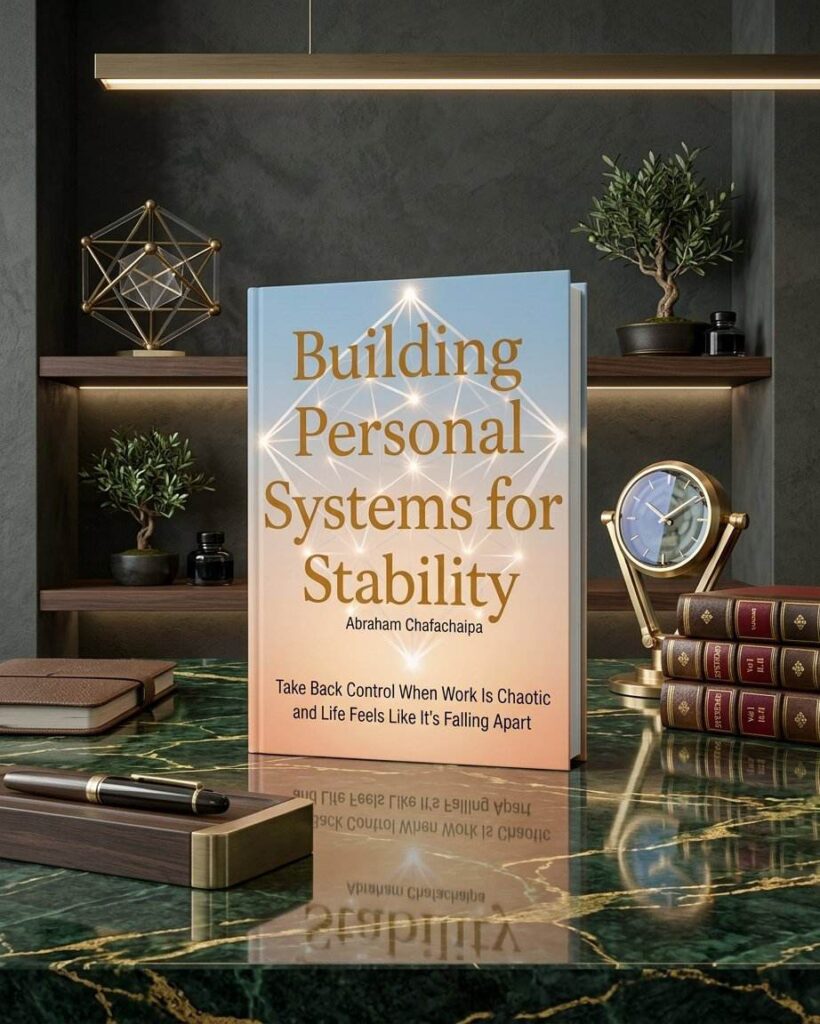
It is one protocol from the larger Personal Operating Framework inside my manifesto, Building Personal Systems for Stability: Take Back Control When Work Is Chaotic and Life Feels Like It’s Falling Apart.
First, let’s name the problem.
What Is Reaction Mode?

Reaction mode is a state in which incoming demands determine your priorities more often than deliberate decisions do.
Your inbox cannibalizes your task list.
Notifications shatter your focus.
Other people’s urgency dictates your schedule.
Unexpected problems devolve into the organizing principle of your day.
By subtle degrees, you stop asking:
«”What matters most today?”»
And start asking:
«”What needs my attention right now?”»
Those questions sound similar.
They aren’t.
The first creates direction.
The second creates reaction.
When you stay in this posture until fatigue hardens into habit, the consequences compound:
More interruptions → more decisions → greater cognitive load → less clarity → more reactive decisions → more unfinished work.
This is why traditional time-management advice can feel strangely inadequate during chaotic periods.
The issue isn’t always that you have too little time.
More often, the problem is that your attention has no protection.
7 Signs You Are Living in Reaction Mode

Before trying to fix your productivity, determine whether reaction mode is actually the problem.
- Your inbox sets your agenda
You begin the morning knowing exactly what you want to accomplish.
Until you open your email.
An hour later, you are working on someone else’s priorities.
- You are constantly busy but rarely feel finished
Your day contains meetings, calls, messages, admin and problem-solving.
Yet when you look back, you struggle to identify the meaningful outcome you produced.
- Everything feels urgent
A genuine emergency and a minor request trigger almost identical levels of attention.
Your brain begins treating “loud” as “important.”
- Your priorities keep changing
You choose a priority at 8 AM.
A problem appears at 10 AM.
A request arrives at noon.
By 3 PM, the original plan has disappeared.
- You take work home mentally
You close your laptop.
But the work doesn’t close.
Shadows of unfinished tasks follow you to dinner, hover over conversations with your partner, and keep watch while you try to sleep.
- You repeatedly rebuild your productivity system
New app.
New planner.
New calendar.
New productivity method.
New Monday.
Same underlying instability.
The tool is rarely the flaw.
The missing piece might be the system operating behind the tool.
- Your productivity system collapses during difficult weeks
This is the biggest warning sign.
If your system only works when you are rested, motivated, and uninterrupted, it collapses in contact with reality.
A stability system must have a way to respond when conditions fracture.
How Do You Stop Living in Reaction Mode?

Stability demands no complicated schedule.
It carves out a pause between what happens and what you do next.
Such pause gives you an opportunity to regain control of your attention.
Inside Building Personal Systems for Stability, I call one version of this the 5-Minute Reset.
It is designed for exactly those moments when your thinking becomes foggy, your workload feels impossible and you are tempted to react to everything simultaneously.
This is the complete approach.
The 4-Step Reset for a Chaotic Week

Step 1: Stop
Stop consuming information.
Close your inbox.
Put your phone down.
Pause the messaging channels.
Stop adding new inputs for a few minutes.
You don’t need to solve anything yet.
You are simply interrupting the stream.
Reaction mode thrives on the constant bleed of incoming noise.
Every new message forces another decision.
Every notification demands an opportunity to abandon your current priority.
Every interruption fragments attention further.
So the first move is counterintuitive:
Don’t do more. Stop.
Give your brain a few minutes in which nothing new is asking for an answer.
Step 2: Clear
Take a sheet of paper.
Write down everything currently occupying your mind.
Everything.
⦁ The unanswered email.
⦁ The deadline.
⦁ The meeting.
⦁ The personal responsibility.
⦁ The bill.
⦁ The conversation you are avoiding.
⦁ The project you are worried about.
⦁ The thing you promised someone last week.
Don’t organize it yet.
Don’t prioritize it yet.
Just get it out.
Your mind is an extraordinary instrument for thinking.
It is a terrible place to store every open commitment.
When unfinished tasks remain mentally scattered, your brain has to keep reminding you that they exist.
Externalizing them establishes psychological and operational separation.
You can now see the problem.
You no longer need to carry it.
Step 3: Choose
Now ask yourself:
“What is the one thing I need to do next to stay in the game?”
Not:
“What would make everything perfect?”
Not:
“How do I catch up on everything?”
Not:
“How can I finish this entire week?”
One thing.
When you are overwhelmed, trying to solve everything simultaneously creates more decision fatigue.
The objective is to establish a stable point.
One day, that means executing the single critical deliverable.
Another, it means holding the line on a deadline.
Or communicating a hard delay.
Or tackling the urgent personal fire which threatens to burn through everything else.
On a difficult day, progress rarely resembles peak performance.
Here, progress is damage control.
That holds the line
Step 4: Begin
Once you have identified the one thing, take the smallest concrete action that moves it forward.
⦁ Open the document.
⦁ Write the first paragraph.
⦁ Send the message.
⦁ Make the call.
⦁ Pay the bill.
⦁ Schedule the appointment.
Start.
Don’t spend another twenty minutes architecting a perfect plan.
The purpose of the reset is to move you from:
overwhelm → clarity → action.
Five minutes can pivot the trajectory of the next few hours.
A Simple Example

Imagine it’s Wednesday afternoon. Your morning disappeared into meetings.You have an important deliverable due Friday. Your inbox contains 37 unread messages.Someone on your team needs help. Your personal responsibilities are piling up.
You are switching between email, Slack or Teams, your calendar, your project management tool and your phone.
You feel that familiar thought:
“I don’t even know where to start.”
Don’t start by working harder.
Run the reset.
STOP: Shut down the incoming channels.
CLEAR: Put every competing commitment on paper.
CHOOSE: Identify the one action that protects the most important outcome.
BEGIN: Take that action.
You have just built something extremely valuable:
a deliberate decision between the problem and your response.
That is a tactical victory.
Yet here lies the vulnerability most systems ignore.
Why the 5-Minute Reset Fails Under Pressure

If the reset works, you may feel clearer.
You may regain momentum.
You may rescue an otherwise unproductive afternoon.
But tomorrow another chaotic situation can appear.
And the next day another one.
This is because a protocol is not an operating system.
A reset helps you recover when your system is overloaded.
It doesn’t answer every question about how your life should operate.
For example:
What determines your priorities tomorrow morning?
How do you protect deep work?
Where do unfinished commitments go?
How do you separate important work from shallow administrative work?
How do you manage recovery?
What happens when your energy collapses?
How do you make decisions under pressure?
How do you review your system before it quietly stops working?
What happens when the crisis lasts for weeks rather than hours?
The 5-Minute Reset doesn’t answer all of those questions.
It isn’t supposed to.
It is one component of a larger architecture.
By design.
The Difference Between a Productivity Hack and a Personal System

A routine is a sequence of behaviours.
A system is larger.
A system yields reliable results across changing conditions.
Your morning routine might include exercise, coffee and planning.
Useful?
Absolutely.
But what happens when you wake up late?
What happens when your child needs you?
What happens when work becomes chaotic?
What happens when you’re exhausted?
What happens when the plan you made yesterday becomes irrelevant?
A real system needs a fail-safe switch.
When pressure spikes, it shouldn’t blindly demand peak performance.
It must adapt.
This operational core drives Building Personal Systems for Stability.
This blueprint integrates priorities, execution, attention, decision-making, recovery, and review—never as isolated productivity hacks. But as interconnected modules within a personal operating system.
The target is not to construct a life where nothing goes wrong.
Impossible.
The goal is to build a system that refuses to collapse when crisis strikes.
The Michael Story: What This Looks Like in Real Life

One of the stories in Building Personal Systems for Stability follows Michael.
Michael isn’t portrayed as lazy or unambitious.
His problem is almost the opposite.
He is constantly working.
He wakes up already behind.
Messages are waiting.
Meetings overlap.
His commitments are scattered across a notebook, an app, sticky notes and his own head.
He can work all day and still arrive at the evening without a strong sense that anything important has actually been completed.
That’s reaction mode.
The issue isn’t effort.
It’s architecture.
The transformation isn’t Michael discovering a magical productivity trick.
He begins using structures that clarify what matters, where his attention should go and what constitutes meaningful progress.
This blueprint provides a baseline isolated productivity hacks cannot match:
an architecture to return to when conditions unravel.
The outcome promises no fantasy life without difficult days.
The difficult days remain.
But Michael now has greater clarity about what matters, where his energy goes and how to recognize small wins rather than measuring his day by frantic activity.
This is the core promise of personal systems.
Never perfection.
Stability.
Why Time Management Alone Can Fail During Chaotic Weeks

Time management assumes you can make reasonably reliable decisions about how your time will be used. Unpredictable environments disrupt that premise.Your plan turns obsolete before the day is over.
A meeting moves.
A client rewrites the rules while the game is being played.
A deadline accelerates.
A colleague’s load shifts mid-carry.
The home front pulls the emergency brake.
Your energy changes.
The question is no longer simply:
“How should I schedule my day?”
It becomes:
“How should I operate when my day refuses to stay scheduled?”
That is where a Personal Operating Framework outstrips another calendar technique. A calendar tells you when something should happen.A system helps you decide what happens when reality interferes.That’s a much more sophisticated form of personal organization.
The $77 Question: What Are You Actually Buying?

If all you needed was the 5-Minute Reset, this article would be enough.
Use it.
Keep the four steps somewhere visible.
Run it the next time your week starts spiralling.
You don’t need to purchase a manual to execute those four steps.
But if your problem spans beyond one chaotic afternoon, a single micro-fix is only the baseline.
That’s why Building Personal Systems for Stability: Take Back Control When Work Is Chaotic and Life Feels Like It’s Falling Apart rejects the cheap collection of productivity hacks.
It’s a complete blueprint for building personal stability systems.
The manual takes you beyond:
“How do I get more done?”
and into:
“How should my life operate when motivation disappears, conditions change and pressure increases?”
Inside the broader framework are structures for:
- establishing deliberate daily priorities
- creating a Daily Success Loop
- protecting attention through a Daily Operating System
- separating deep work, shallow work and recovery
- getting commitments out of your head
- reducing decision fatigue
- making better decisions under pressure
- reviewing and recalibrating your systems
- recovering when circumstances become genuinely difficult
- closing the day so unfinished work doesn’t follow you into the night
That is the difference between purchasing information and investing in operational infrastructure.
The $77 isn’t for a handful of tips.
It’s for the blueprint connecting the pieces.
What Should You Do Today?

Don’t attempt to rebuild your entire life.
Start with the reset.
The next time you notice yourself bouncing between demands, stop.
STOP
Interrupt incoming information.
CLEAR
Put what’s occupying your mind onto paper.
CHOOSE
Identify the one thing you need to do to stay in the game.
BEGIN
Take the next concrete action.
Then notice what happens.
You may discover your primary failure point was never a lack of effort.
You simply lacked a deliberate mechanism to reclaim clarity once chaos took over.
This realization alters the target.
The moment this shift locks in, you cease searching for another productivity app and begin engineering systems.
Frequently Asked Questions About Reaction Mode
What does it mean to live in reaction mode?
Living in reaction mode means allowing incoming demands, interruptions and other people’s priorities to determine most of your actions instead of deliberately choosing what matters most.
How do I know if I’m in reaction mode?
Common signs include constantly checking messages, changing priorities throughout the day, feeling busy without meaningful progress, carrying unfinished work into the evening and experiencing everything as urgent.
How do I stop being so reactive?
Start by creating a pause between incoming demands and your response. A simple reset is to stop incoming information, clear your mental commitments onto paper. Choose one priority and immediately begin the next concrete action.
Is reaction mode the same as burnout?
No. They can overlap, but they are not identical. Reaction mode describes how you are operating under continuous demands. Burnout is a broader condition involving prolonged occupational or life stress and can involve exhaustion, detachment and reduced effectiveness.
Does better time management solve reaction mode?
Not always. Time management can help. However, unpredictable environments require more than scheduling. You also need systems for priorities, attention, decisions, recovery and adapting when circumstances change.
What is a Personal Operating Framework?
A Personal Operating Framework is a connected set of structures that helps you decide how to manage priorities, attention, execution, recovery and decisions across changing conditions.
Your Life Doesn’t Need to Be Predictable to Become Stable
Stability doesn’t mean nothing goes wrong.
It means something remains intact when things go wrong.
Your career can descend into chaos.
Your workload can increase.
Your plans can change.
Your energy can fluctuate.
Life can throw something at you that wasn’t on the calendar.
True stability requires no total control over the environment.
The focus remains on constructing hardened structure so chaos cannot overwrite your operating system.
The 5-Minute Reset is one place to begin.
But it’s only one piece.
If you are tired of constantly reacting, repeatedly rebuilding your productivity system and wondering why everything falls apart during difficult weeks, it’s time to move beyond isolated tactics.
Build the system underneath your life.
That’s what Building Personal Systems for Stability—Take Back Control when work is chaotic and life feels like it’s falling apart was created to help you do.
Your best week doesn’t need much protection.
Your worst week does.
If this article made you think of a colleague, friend, partner, manager or family member who is quietly living in reaction mode, send it to them.
They may not need another productivity tip.
They may need a better way to understand what is happening.
Share this article with someone whose life looks organised from the outside—but feels chaotic on the inside.
Execution Check: Which of the 4 reset steps will you deploy the next time your day breaks?
Drop your answer in the comments below.I read and reply to every single response.