
You earn good money.You have responsibilities people trust you with.Your calendar is pinned because your career is moving. From the outside, everything probably looks fine.
The problem no one talks about:
Your career is consuming the life it was supposed to support.
You finish work and you’re physically home, while mentally you’re still in the office. You sit at dinner thinking about the email you didn’t answer.You spend Saturday morning catching up because Friday disappeared into meetings.You tell your partner, your children, your friends or yourself:
“Things will calm down after this project.”
Project 4 drops.
Another deadline.
Another client.
Another promotion.
Another crisis.
The system buckles. You start searching for the next productivity hack.
Better time blocking.
A better calendar.
A better task-management app.
A new morning routine.
A more disciplined schedule.
What if the problem is that you need something other than better time management?
What if you are trying to solve a systems problem with a time-management tool?
That’s the distinction behind the Personal Operating Framework I developed in Building Personal Systems for Stability.Today, I’m giving you one practical piece of that framework.One approach you can use tonight.It can give you a genuine win. Yet it will also reveal why the method alone falls short.
The Real Cost of a Successful Career

A six-figure career can set up a strange kind of trap.The better you become at handling responsibility, the more responsibility tends to find you. You are the fixer of failures. Others keep adding weight to your shoulders.
You are reliable.
So you are given more deadlines. You are competent. You are the one everyone calls when something breaks.Over time, your professional competence starts paying the bill for your personal exhaustion.
You can still perform.
Unseen failure is lethal failure. You cleared the deadline. You answer the client.You attend the meeting. You deliver the presentation. You make the money.
You are paying for that performance somewhere else.Maybe it’s your evenings.Maybe your relationships. Maybe your sleep.Maybe your ability to enjoy a Saturday free of guilt.Maybe it’s merely the feeling that you are never completely off. Better time management bleeds.
Time management asks:“How can I fit more into the available hours?”
A personal operating system asks:“How should my life operate when demands exceed the available hours?”
Those are two completely different questions with two completely different answers.
The One System: The Evening Close

This is the protocol. It’s called the Evening Close. The purpose is deceptively straightforward. Your workday needs an ending. Not a loose ending. Not “I’ll stop when everything is finished.” Since everything will never be finished. Deliberately, you close the workday so your brain doesn’t have to continue carrying unfinished business into your personal life.The Evening Close breaks into four moves:
1. FINISHED
Log what you actually completed.Forget what you planned to finish. Forget what you spent time working on. Count only what made it to done.
For example:
– Client proposal submitted.
– Budget reviewed.
– Three emails answered.
– Presentation outline completed.
This draws a factual boundary around the day.You can say:”This is what happened today.”
2. OPEN
Now identify what’s unfinished.
Don’t solve it.
Don’t start working on it.
Just capture it.
For example:
– Send revised proposal.
– Review contract.
– Call accountant.
– Prepare Monday presentation.
– Follow up with Sarah.
The objective is to get unfinished work out of your head.Your brain is terrible at being both a workplace and a storage facility.When unfinished tasks remain mentally active, they continue demanding attention even after the laptop closes. Capture the unfinished tasks.
3. PLACED
This is where the tactic becomes more powerful.An unfinished task isn’t closed simply because you have written it down. It needs a home. Decide where it belongs.
Tomorrow?
Later this week?
Next week?
Waiting for somebody else?
Not important anymore?
For example:
Tomorrow: Send revised proposal.
Wednesday: Review contract.
Waiting: Sarah’s response.
Later: Research new software.
You are completing less than everything. Forge certainty about where everything belongs.
4. TOMORROW
Choose the first meaningful outcome for tomorrow. Rather than ten priorities. Rather than a giant task list. One outcome.
For example:«”By 10:00 AM tomorrow, the revised client proposal is submitted.”»
Now tomorrow-you doesn’t have to wake up and negotiate with yesterday’s chaos.The first move has already been decided. The you who wakes up tomorrow receives instructions instead of questions.
Try It Tonight

You need zero expensive productivity apps.Take five minutes before you finish work.
Write:
FINISHED
What did I actually complete?
OPEN
What remains unfinished?
PLACED
Where does each unfinished item belong?TOMORROW
What is the one meaningful outcome I will pursue first?
Then close the notebook.
Close the laptop.
Leave.
That’s it.
Do this for seven days. You will notice the split and get clean at leaving work at work.Your workload didn’t disappear. Containment logged.
Where This Approach Breaks Down
The fault line is here : most productivity advice shears. Someone discovers the Evening Close and thinks:”Great. I’ve found the answer.”
No.
You have found one structural component which is a vital distinction. Imagine trying to build a house with only a front door.The door is useful. You need it. Still, you wouldn’t call it a house. The same is true here. The Evening Close helps you stop carrying unfinished work into the evening.
But what happens tomorrow morning?
What determines what you work on first?
What protects your attention?
What happens when five people declare their requests urgent?
What happens when your schedule explodes?What happens when you are exhausted?
What happens when an unexpected family problem suddenly lands on your doorstep?
What happens when you miss three days?What happens when the system fails?
That’s where a Personal Operating Blueprint governs over a productivity hack. The framework has to account for changing conditions.
Your Life Doesn’t Operate Like a Calendar

Traditional time management quietly assumes something that real life constantly disproves: That tomorrow will resemble today. Your calendar doesn’t control reality.Your client can call. Your child can need you.Your colleague can trigger an emergency.
A project can go critical.
A money problem can surface overnight.
Your energy can drain away with it.
A relationship can pull hard for attention.
Your carefully constructed schedule can become irrelevant before lunch.
You are chasing something far more useful than a flawless day. You are building a structure sturdy enough to bend when life hits hard, recover its shape, and keep carrying you forward.That is the philosophy behind System-Based Stability.
Your system needs a filter to distinguish:
– What must happen now
– What can wait
– What should be delegated
– What should be captured
– What deserves your best attention
– What can be reduced
– What can be abandoned
-What needs a decision
– What doesn’t deserve a decision at all
If those mechanisms are missing, you default to manually managing everything.Before long, you are going to run out of cognitive capacity.
This Is What Happened to Michael
There’s a story in Building Personal Systems for Stability about Michael. Michael wasn’t incompetent. That was the problem.
He knew his work. He put in the hours. When something needed doing, he carried the weight.His commitments, however, existed everywhere.Michael’s to-do list lived in a notebook, a phone app, sticky notes and his head.
One morning, he woke up already behind. Messages were waiting.A client wanted a report. His calendar contained overlapping meetings. By the end of the day, he had worked constantly but couldn’t identify one meaningful thing he had actually finished.
That is the kind of person conventional productivity advice often misunderstands.He didn’t need someone to tell him to “work harder.” He was already working hard.
Michael needed structure.
The manual’s central argument is deliberately different from conventional productivity thinking: The aim shifts from wringing extra output out of every hour. It shifts toward building structures that hold steady when motivation vanishes, energy bottoms out, and life turns loud.That’s a much bigger problem.Therefore, it requires a bigger solution.
The Difference Between a Routine and a Personal Operating Framework

A routine tells you what to do. A system helps determine what to do when circumstances change. That’s the separation.
You can have a beautiful morning routine and have a chaotic life. You can have a color-coded calendar and spend your evenings thinking about work. You can have a task-management application with hundreds of features and feel completely behind.
The reason is that the problem isn’t always execution. At times, the problem is the structure surrounding execution. A real system needs a kind of circuit breaker. When conditions deteriorate, it shouldn’t demand that you perform like everything is normal.
It should shift.
The Personal Operating Blueprint describes this as the difference between a collection of habits and a real system: when conditions deteriorate, the system needs a survival mode rather than simply collapsing. That quality makes the framework valuable to someone whose work and personal life are genuinely unpredictable.
The Personal Operating Framework Behind the Evening Close
The Evening Close is only one piece. Behind it is a broader architecture. There is a way to determine your most important outcome.There is a way to organize commitments so your mind isn’t carrying everything simultaneously.
There is a way to protect attention using different operating zones.
There is a way to make decisions under pressure without letting urgency hijack judgment.
There are review cycles that prevent the system from slowly becoming irrelevant.
There is a reset process for when the wheels come off.
When maintaining the entire system becomes unrealistic: There is a Single Anchor. The Personal Operating Framework specifically frames the Single Anchor as the practice you maintain during crisis—the one thing that keeps you connected to your own judgment when everything else is under pressure.
Don’t mistake today’s protocol for the whole solution.
Use it.Get the win. Notice what happens next. The moment you experience the benefit of one small piece, you will see the larger problem more clearly.
Your Objective Is Not to Optimize for Being Busy
This could be the most important shift.Your goal isn’t:”How can I handle even more?”
Your goal is:”How can I remain effective without allowing work to consume everything else?”
Those aren’t the same ambition. The first produces increasingly efficient exhaustion. The second produces stability. Stability is what allows success to compound.Your career should fund your life. It shouldn’t quietly consume it. Your work should have boundaries. Your attention should have protection. Your commitments should have somewhere to go. Your decisions should have rules.Your difficult weeks should have a survival mode.
You will fall out of the system. Every human does. You need a door back in. My blueprint’s philosophy is resumption.You need a system which works even when the week is a mess. You need one that catches you before everything slips.
Start Tonight—but Don’t Stop Here

Tonight, perform the Evening Close.
Five minutes.
Four headings:
FINISHED.
OPEN.
PLACED.
TOMORROW.
Audit what changes.Maybe you sleep better. Maybe dinner feels different. Maybe you stop checking your email at 9:30 PM.Maybe you wake up knowing exactly where to begin.
That’s your first win.Don’t confuse the first brick with the building. The Evening Close solves one problem:unfinished work following you into your personal life.
The larger problem is how your entire life operates when work becomes chaotic. That’s the problem my manual called , Building Personal Systems for Stability, is designed to solve .
I don’t want you to buy another productivity book full of tricks you will abandon in three weeks.I want you to build a Personal Operating Framework—a practical blueprint for staying clear, directed and functional when the conditions around you aren’t cooperating. After all , your best day doesn’t need saving.Your worst day does. That’s where a real personal system earns its keep.
If This Described Someone You Know, Send It to Them
There is probably someone in your life who is doing exactly what we described here.The high-performing friend who is always “busy.”The manager who answers emails during dinner. The parent who is physically present but mentally still at work.The entrepreneur who can’t remember the last weekend they genuinely switched off.
The professional who keeps saying:
“Once things calm down…”
If this article made you think of someone, send it to them. Another productivity tip may be the last thing they need. What they may need instead is to see that their discipline isn’t necessarily the problem. It may be their system.
If you’ve tried the Evening Close, I’d genuinely like to know:
- What changed for you?
- Did you sleep better?
- Did you stop thinking about unfinished work?
- Did you wake up with more clarity?
- Or did you discover another problem underneath it?
Leave a comment below and tell me what happened.
Your experience could be the exact thing someone else needs to read before they realize they’re not failing . They are operating absent a structure designed for the life they are actually living.
If you know someone who is quietly drowning in a successful career, share this article with them.Sometimes word-of-mouth starts with you saying:”Hi, I read this and immediately thought of you.”That might be all it takes to help someone take back control.
Build the System, Beyond the Schedule
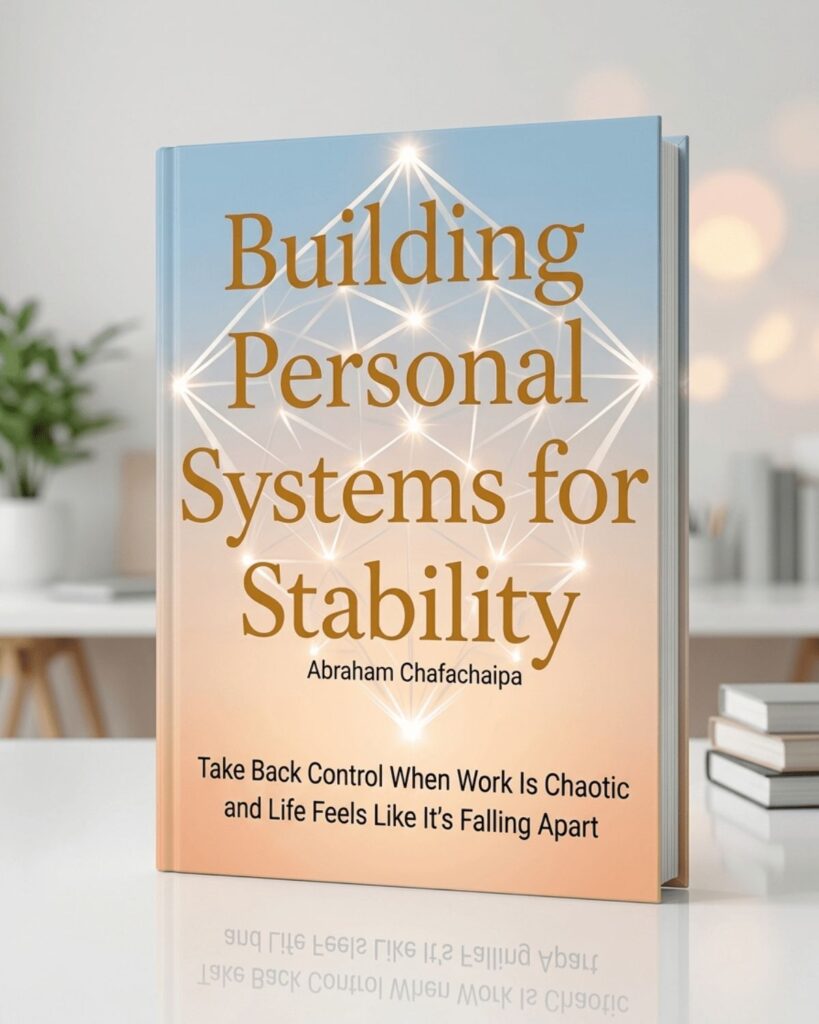
Time management can help you organize a day. A Personal Operating Framework helps you navigate a life.When your career, responsibilities and personal life are tugging you in opposite directions, that distinction sharpens into destiny.
Start with the Evening Close tonight. Get the small win. When you’re ready to stop patching one issue after another and build the structure underneath them, go deeper with: