

Most productivity advice is running a con job on you.
Check the sleight of hand:
“If you want it badly enough, you will find the discipline.”
Feels like a pep talk.
It’s actually a pipe bomb with a bow on it.
Willpower doesn’t live in your personality.
Willpower is a battery.
Some days the grid goes down.
Case in point — two Tuesdays:
Tuesday A: 8 hours of sleep. Coffee’s hot. Inbox is quiet.
Tuesday B: 4 hours of sleep. Client’s furious. Surprise bill. Three “URGENT” emails. A meeting that could have been a text. Plus, a crisis waiting at home.
Same you. Same goal. Same “want it badly enough.”
Completely different human.
Every productivity guru hands you the same planner, the same 5AM routine, the same spreadsheet — as if Tuesday A and Tuesday B are twins.
They aren’t even distant cousins.
Discipline isn’t the engine. It’s the weather.
Stop building your life on the assumption that the sun always shows up.
Build for the storm instead.
You no longer need more willpower.
You need a system that survives you on your worst Tuesday. One that keeps running when you are already winning.
When conditions deteriorate:
Motivation stops showing up.
Decisions start feeling like mountains.
Focus shatters into static.
Every small unfinished promise becomes a pebble in your shoe. You can’t walk, you can’t stop feeling it, and you can’t shake it loose.
Somewhere between Tuesday and burnout, you find yourself saying:
“I know what I should be doing. I just can’t seem to make myself do it.”
The villain isn’t discipline.
The villain is infrastructure.
Your life needs a backbone sturdier than your mood.
Your life is asking for a Personal Operating System.
What Is a Personal Operating System?

A Personal Operating System is the structure you use to produce reliable results when conditions change.
Forget the productivity apps.
Skip the 14-step morning routines.
Ignore the color-coded calendars.
And cross off the hollow pledge to “try harder.”
A routine gives your habits an order.
A system goes further.
A system provides a framework for producing reliable results across changing conditions. It determines what happens when your normal plan works—and what happens when it doesn’t.
A breezy, blue-sky Tuesday doesn’t test your architecture.
A wreck of a week does.
The Problem With Using Willpower as Your Backup Plan

Picture building your financial life around this strategy:
“If something goes wrong, I’ll simply earn more money.”
That isn’t a financial system.
It’s a hope.
Yet people often build their productivity around an almost identical strategy:
“If things get chaotic, I’ll just become more disciplined.”
That is not a stability system.
It’s dependence on a resource that grows less dependable precisely when you need it most.
Your inbox turns into a flood.
So you tell yourself you will work harder.
Your calendar starts swallowing your days whole.
You tell yourself you will get more organized.
Your priorities start breeding.
You tell yourself you’ll get more focused.
Then life stops asking nicely.
A diagnosis. A parent who needs you. A marriage going quiet. The kind of thing that doesn’t care about your systems, your streaks, or your five-year plan.
The whole thing — every habit, every routine, every carefully stacked brick — comes down like a house of cards.
This is why personal stability cannot be built entirely around motivation.
Your system has to shrink the number of decisions you have to make.
It has to strip out friction.
And it has to make the next useful action obvious.
Right here is where one of the simplest systems in my operating manual begins.
The Daily Success Loop: One Small System You Can Build Today

The Daily Success Loop is designed around four components:
- One outcome
- Direct actions
- A trigger
- Friction removal
Together, these create a structure that can operate without requiring you to repeatedly negotiate with yourself.
I’m going to give you one piece of this system in full.
No teaser.
No missing step.
You can use it today.
The mandate is:
Pick One Outcome

Nine out of ten of us wake up already behind.
Five things.
Ten things.
Twenty things.
Then life pulls the rug.
The list expands.
The priorities compete.
Everything piles at once.
Your brain spends the morning deciding what deserves attention instead of actually producing results.
The Daily Success Loop starts differently.
Pick one outcome.
Not ten.
One.
The outcome must be specific enough that you can tell whether you achieved it.
“I want to be productive” doesn’t work.
“I want to make progress on my business” is still vague.
A useful outcome might be:
“Before 9 AM, I will have identified my three most important tasks and prepared my workspace for focused work.”
Now success is visible.
You either did it or you didn’t.
There is no complicated productivity score.
No debate.
No need to ask whether you were “productive enough.”
The system gives you a clear finish line.
As the blueprint puts it, vague outcomes create vague effort. Systems work better when success is obvious.
Why One Outcome Is So Powerful

.
The temptation is to believe that more priorities spark more progress.
Usually, they generate more cognitive noise.
When everything screams for your attention, nothing gets heard.
Consider the difference.
Approach One
You wake up and think:
⦁ Answer emails
⦁ Exercise
⦁ Finish the report
⦁ Check Slack
⦁ Pay the bill
⦁ Call the client
⦁ Review the presentation
⦁ Research the proposal
⦁ Plan the week
⦁ Organise your files
Your brain immediately has to negotiate:
What first?
Then:
What next?
Then:
Is this more important than that?
Then something arrives in your inbox.
The entire hierarchy changes.
Approach Two
You wake up knowing your first outcome.
You get to skip solving your entire life.
You get to chase one clearly defined result.
A far lighter cognitive load.
Lighter cognitive loads are easier to execute consistently.
Try This Tomorrow Morning

Take a sheet of paper.
Before opening your inbox, write:
TODAY’S ONE OUTCOME:
By ________, I will __________________________.
Now ask:
What would make this outcome unquestionably complete?
Make the answer concrete.
For example:
By 9 AM, I will identify my three highest-priority tasks and prepare my workspace for focused work.
Now you have something your brain can execute.
An aspiration won’t suffice.
A motivational statement won’t move the work forward.
An operational target will.
The first breakthrough arrives.
From there, a small change in structure can produce a surprisingly powerful shift.
Your First Real Win

Suppose you normally begin the day by checking your phone. One message spirals into five. Five swells into fifteen.
One email requires a response. This reply triggers another task. A notification arrives. It’s not about what you expected. Before you have consciously chosen what matters, your day has already chosen for you.
The One Outcome interrupts that pattern.
You establish the destination before the environment starts issuing instructions.
That’s a win worth celebrating.
You have reclaimed the first decision of the day.
But don’t mistake the win for the whole system.
This is where most productivity advice goes wrong.
Why One Move Won’t Cut It

Let’s say you successfully choose one outcome every morning.
Excellent.
But what happens at 11:30 AM?
Your manager sends an urgent request.
At noon, a client changes the scope.
At 2 PM, your inbox contains 27 unread messages.
At 4 PM, you are exhausted.
At 7 PM, you remember the personal commitment you forgot.
Tomorrow morning, you choose another One Outcome.
The unresolved commitments linger.
The competing priorities pile up.
Your attention stays fragmented.
Your financial pressure presses on.
Your decision-making problem remains.
Your recovery problem won’t budge.
The Daily Success Loop can crack the door open. It can give you your first honest foothold on solid ground.
But a foothold can only carry so much weight. When work, money, commitments, and personal demands bear down on you simultaneously, the Loop reaches its limits. It handles the immediate move. The rest requires something larger.
A Personal Operating System becomes the ground beneath everything else—the structure that keeps your life from tipping when pressure arrives from every direction.
The Story That Explains Everything

Consider Michael.
He is deliberately ordinary.
No extraordinary circumstances.
No dramatic success story.
Just someone trying to keep work and life moving.
One morning, he woke up already behind. Messages were waiting before he had even made tea. One concerned a client. Another involved his landlord. Another came from his sister.
His calendar contained overlapping meetings. His tasks existed in multiple places: a notebook, a phone application, sticky notes, and his head. By the evening, he had worked continuously.
He had answered messages. Attended meetings. Prepared for other meetings.
Skipped lunch.
Stayed busy.
After everything, Michael couldn’t identify one meaningful thing he had actually finished.
Motion can look exactly like progress. You can spend ten hours moving and still end the day without moving the important thing.
Michael’s problem wasn’t a lack of effort.
He had plenty of effort.
His problem was that effort had no sufficiently stable structure around it.
What a Real Personal Operating System Does Differently

A Personal Operating System doesn’t assume that tomorrow will resemble today. Such a system anticipates changing conditions. Which means yours needs more than a morning routine.
It needs structures for:
⦁ · deciding what matters
⦁ · managing information
⦁ · handling commitments
⦁ · protecting attention
⦁ · working under pressure
⦁ · making difficult decisions
⦁ · reviewing and resetting
⦁ · recovering after disruption
⦁ · maintaining financial order
⦁ · closing the day properly
These are no mere productivity hacks.
They are connected components of a broader operating architecture.
Your daily priorities interact with your attention.
Your attention interacts with your commitments.
Your commitments interact with your decisions.
Your decisions interact with pressure.
Pressure affects your ability to execute.
The moment execution breaks down, you need a way to reset rather than simply declare yourself undisciplined.
Building Personal Systems for Stability moves beyond isolated habits and routines.
It underwrites the infrastructure underneath them.
The full framework includes the Daily Success Loop, Daily Operating System, Four Rooms, information and commitment systems, financial structure, decision filters, review cycles, the 5-Minute Reset, Recovery Loop, three people, and Evening Close.
Your System Should Have a Bad-Week Mode

We build our lives out of blue skies and pristine calendars, convincing ourselves that control sits one color-coded task list away.
Life doesn’t ask for permission before it unravels. It just arrives, heavy and unannounced, in the quiet middle of a Tuesday.
The body falters. You wake up to a frame that refuses to carry the load, where staying awake turns into slow-motion effort.
Grief takes the wheel. A phone call pulls the floor out from under you, and quarterly goals read like a foreign language.
The math stops working. You sit at your kitchen table under a dim light, staring at numbers that refuse to balance, wondering how a month grew so impossibly long.
The storm hits all at once. Projects implode. Deadlines collapse inward. The quiet neatness of your plans turns to ash in your hands.
The deepest tragedy of modern productivity: we design systems that abandon us the second we bleed. We construct fragile glass palaces that hold up only under bright, unbroken sun. Then we teach ourselves that when the foundation shatters, we are the broken ones.
You are a human being living through an unpredictable, breathtaking, and often crushing world. A system that loves you only when you soar was never built to save you. It was built to harvest your light — then leave you in the dark when you need shelter most.
In the manual, Sarah represents this problem.
Her habits are excellent.
She meditates.
She journals.
She follows her morning routine.
Then a hard week arrives.
A client pulls out.
A landlord sends an aggressive message.
A family member needs help.
Her deadlines begin to blur.
Her routines continue—but her life starts stalling around them.
The lesson is powerful:
A routine can continue while your life falls apart.
A real system needs a circuit breaker.
When conditions deteriorate, it should shift into a mode designed to protect your ability to continue.
On a difficult day, progress may not mean peak performance.
It may mean damage control.
It may mean paying the urgent bill.
Delaying what can wait.
Protecting tomorrow.
That still counts as progress.
This Is the Personal Operating System Blueprint

Think about your life like a business.
A serious business doesn’t say:
“We will figure it out when something goes wrong.”
A serious business creates procedures.
Decision rules.
Financial controls.
Review processes.
Recovery plans.
Priorities.
Escalation mechanisms.
Uncertainty bleeds you — in time, in money, in sleep.
The same principle applies to your personal life.
Your Personal Operating System exists to reduce the amount of uncertainty your brain must solve from scratch every day.
It gives important things a home.
It gives decisions a filter.
It gives your attention boundaries.
It gives difficult weeks a survival mode.
And it gives you a way to return to stability when the plan breaks.
This is System Based Stability.
Far from the fantasy that your life will turn perfectly predictable.
The ability to remain operational when it doesn’t.
Why I Don’t Want You to Buy Another Productivity Book

There are thousands of productivity tips available for free.
Another list of hacks misses the point.
Another morning routine collapses by Wednesday.
And another motivational speech telling you to wake up earlier and try harder? That one insults you.
Information was never the problem.
Integration is.
You need to see how the pieces lock together.
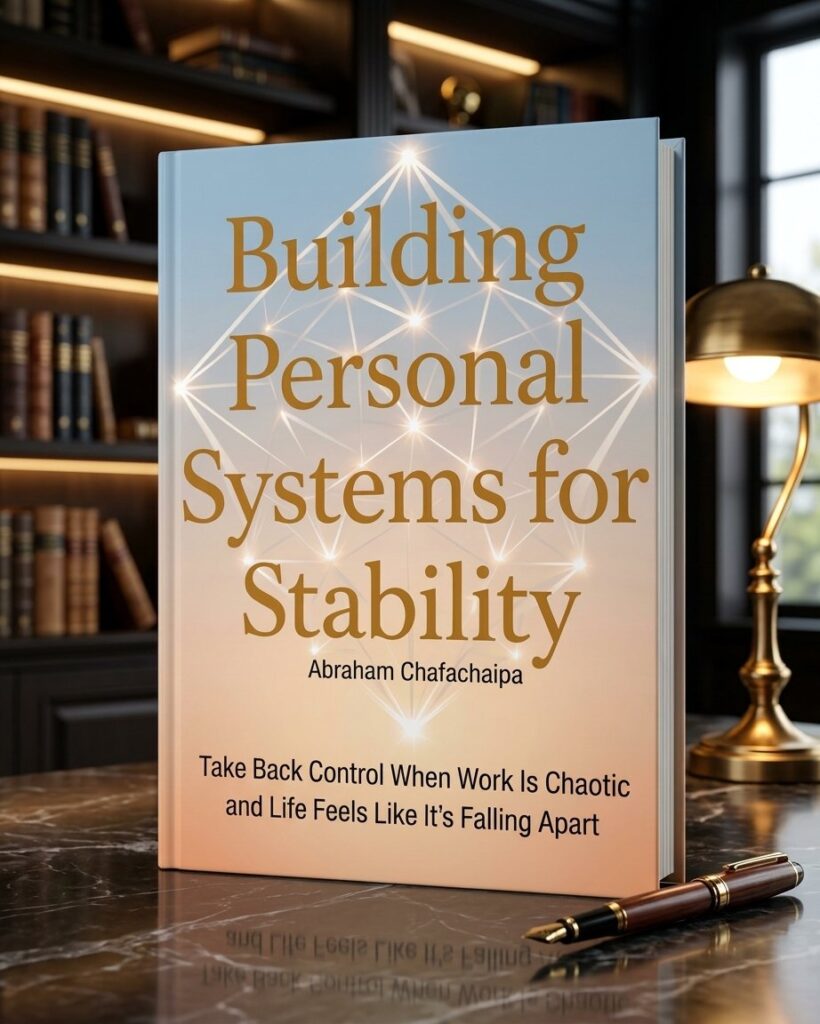
That’s what Building Personal Systems for Stability — Take Back Control When Work Is Chaotic and Life Feels Like It’s Falling Apart was made to give you.
This is no cheap collection of productivity tricks.
This is a complete blueprint for personal infrastructure. One that keeps running when work turns chaotic and life stops behaving predictably.
The $77 price is not for four more productivity tips.
It is for the architecture behind them.
The field manual takes the principle you experienced with the One Outcome and expands it into a broader Personal Operating Framework.
Instead of asking:
“How do I become more disciplined?”
You begin asking:
“How should my life operate when discipline, motivation, time and circumstances are all under pressure?”
Start Small. Build the Infrastructure.

Tomorrow morning, don’t try to rebuild your entire life.
⦁ Take a piece of paper.
⦁ Write one outcome.
⦁ Make it specific.
⦁ Make success obvious.
⦁ Execute it before the noise of the day takes over.
That is your first piece of infrastructure.
If it works, don’t stop there.
Ask yourself:
What else in my life currently depends on willpower?
That question will show you where your system is weakest.
Your inbox.
Your commitments.
Your finances.
Your attention.
Your decisions.
Your recovery.
Your evenings.
Those areas need structure too. Build systems that endure.
Build Something That Holds

Willpower is an emotion. A temporary feeling, like motivation or anger.
Wiring willpower into your daily strategy is like wiring a backup generator into your main power grid. It runs for a few hours. Then it burns out and leaves you in the dark.
Force yourself through every single day, and the setup was already broken. People who stay consistent carry no superhuman strength.
They build lives where they never have to negotiate with themselves at 8:00 AM.
You need a setup that refuses to lean on discipline — one designed around something sturdier than how motivated you feel at 7:00 AM.
Build the structure that works when you feel strong.
Then build the structure that protects you when you don’t.
Here sits the deeper purpose of a Personal Operating System.
Making you operationally resilient.
Want the Complete Blueprint?
If this article gave you one useful protocol, use it.
Seriously.
Don’t just save it.
Tomorrow morning, write your One Outcome and see what changes.
Chaos on the job, or a season where several parts of life crack at once — the One Outcome carries you through one piece of it.
Building Personal Systems for Stability — Take Back Control When Work Is Chaotic and Life Feels Like It’s Falling Apart hands you the complete framework for the structure underneath your daily life.
If you know someone who is constantly working harder but still feels behind, send them this article.
They may not need more motivation.
They may need better infrastructure.
And sometimes one shared idea is enough to help someone realize:
“Maybe I’m not broken. Maybe my system is.”
Your Turn
You’ve read this far, which tells me something: some part of this landed.
So before you close the tab — tell me which part.
What’s the one area of your life right now that depends entirely on willpower?
Your inbox? Your finances? Your evenings? The way you recover after a bad week?
Drop it in the comments. One line is enough. I read every one, and I answer.
And if this gave you a word for something you’d been feeling but couldn’t name — say so. Sometimes naming the problem is the first piece of infrastructure.
Frequently Asked Questions
What is a Personal Operating System?
A Personal Operating System is the structure underneath your daily life — the set of systems that produce reliable results when conditions change. Habits and routines sit on top of it. It decides what happens when your normal plan works, and what happens when it doesn’t.
Is willpower useless?
Willpower has its place. Trusting it with everything? That’s a terrible risk management strategy. It rises and falls. Circumstances shift. Energy drains. A Personal Operating System reduces how often you have to lean on it.
How is this different from productivity hacks?
Hacks optimize a single move. A system holds the whole structure. Another list of hacks misses the point. Another morning routine collapses by Wednesday. You need something that keeps running when the week turns hostile.
What if my whole life feels chaotic right now?
Start smaller than you think. One outcome, written on paper before you open your inbox. That single move interrupts the pattern of reacting all day. Then build outward — one area at a time.
Where do I start?
Tomorrow morning. Take a sheet of paper and write: By ______, I will ______. Make it specific enough that you can tell whether you finished it. Execute before the noise takes over. That’s your first piece of infrastructure.
Do I need willpower to build a Personal Operating System?
You need enough to start. The system takes over from there. The whole point is to shrink the number of decisions you negotiate with yourself — especially at 8:00 AM.